Research
▶️My research interest includes digital competence of pre-service and in-service teachers. To pursue this, I obtained Master's degree in AI Education from Daegu National University of Education, South Korea, and currently I am a PhD student of Learning Design and Technology at Purdue University. Recently, I have been exploring the concept of computational thinking with programming for K-12 level in terms of digital competence.
▶️At the same time, I have been actively involved in the NSF (National Science Foundation) project as a Research Assistant since 2023. This includes contributing to the development of assessment questions aligned with subject matter experts' opinions for the Cyber Training for Open Science in Climate, Water, and Environmental Sustainability initiative. Additionally, I have participated in a learning module design for the NSUE-MOOC (Nurses' Substance Use Education Through an Open, Online Massive Course) in collaboration with stakeholders.
Purdue University (IN, United States) / Research Assistant
2023 - Present
-
VR Classroom Management project (immersive training for pre-service teachers)
- Assisted Dr. Wanju Huang in implementing a VR-based classroom management training application that allows pre-service teachers to practice responding to student misbehavior in an immersive K–6 classroom environment.
- Supported study logistics by coordinating VR sessions, preparing participants, and troubleshooting technical issues so that practice scenarios could run smoothly during teacher education courses.
- Mentored undergraduate research assistants on observation protocols, note-taking, and post-session debriefing to ensure consistent and reliable data collection across sessions.
-
Investigating Barriers to Implementing Artificial Intelligence in K–12 (IRB-2022-1376)
- Conducted virtual, semi-structured interviews with eight K–12 teachers in South Korea to explore their perceptions of AI, classroom applications, and barriers to adopting AI tools in schools.
- Transcribed, organized, and qualitatively coded interview data to identify themes related to infrastructure, teacher agency, curriculum alignment, and ethical concerns in AI implementation.
- Contributed to analytic memos and draft write-ups summarizing implications for AI curriculum design and teacher professional development in K–12 contexts.
-
C.A.R.E. Lab projects (Computer Science, AI, Robotics, Emerging Technologies)
- Collaborated with the C.A.R.E. Lab on projects that explore computer science, artificial intelligence, robotics, and emerging technologies (such as VR/AR) in education, with a focus on K–12 learners and teacher preparation.
- Conducted literature reviews and environmental scans of AI and emerging technology tools to support the design of learning modules and research studies on “learning through AI” and “learning about AI.”
- Contributed to improving asynchronous AI coursework by providing feedback on content structure, activity design, and tool integration to better support self-paced learning for graduate students.
- Assisted with data management and documentation across lab projects, helping maintain organized, reusable datasets and research records.
-
Cyber Training for Open Science in Climate, Water, and Environmental Sustainability
- Participated in a cyber training initiative that develops curriculum and learning modules to help students and researchers use data, simulation tools, and cyberinfrastructure for climate, water, and environmental sustainability.
- Supported the design and refinement of learning activities that introduce foundational and advanced skills in data processing, visualization, and open science practices for climate and water domains.
- Helped design survey instruments to gather participant feedback on the training modules and drafted summary reports based on the collected data to inform iterative improvements to the curriculum.
- Assisted with organizing materials and documenting module structure and revisions for dissemination on an open, scalable training platform.
-
NSUE-MOOC course design research (Nurses’ Substance Use Education MOOC)
- Collaborated with nursing and learning design faculty on research related to NSUE-MOOC, an open online course designed to mainstream substance use education for undergraduate and practicing nurses.
- Reviewed MOOC modules, learning objectives, and assessments to provide feedback on clarity, alignment with nursing education competencies, and opportunities to enhance learner engagement.
- Improved an AI voice generation workflow so nursing faculty could produce narrated slide content without recording their own audio, streamlining the creation of high‑quality lecture videos for the MOOC.
Purdue University (IN, United States) / Graduate Assistant
2024 - Present
-
Graduate research on AI in education
- Participated as a Graduate Research Assistant on AI-in-education projects, contributing to research design, data analysis, and collaborative scholarly writing.
- Assisted with literature reviews and synthesis related to AI literacy, AI-supported teaching, and implications of generative AI for P–12 learning environments.
-
AI projects and courses under Prof. William Watson
- Worked on AI-related projects and course activities under the direction of Professor William R. Watson, whose work focuses on leveraging technology and AI for personalized learning and new paradigms of education.
- Supported the development and refinement of AI-focused learning activities, assignments, and feedback for graduate students and educators exploring applications of AI in P–12 contexts.
-
Purdue AI in P–12 Education Conference support
- Assisted with the Purdue AI in P–12 Education Conference by reviewing presentation submissions, providing formative feedback aligned with the conference’s focus on AI for P–12 teaching and learning.
- Supported conference preparation and logistics, including organizing proposal information, communicating with presenters, and helping ensure a smooth program for attending educators and researchers.
DNUE, Artificial Intelligence Education Lab (Daegu, South Korea) / Researcher
2021 - 2023
-
Foundation for AI education through software development and data-based problem solving
- Conducted research on how software development and data-driven problem-solving activities can serve as a foundation for K-12 artificial intelligence education and AI literacy.
- Designed learning tasks that connect students' everyday contexts to AI-related concepts, emphasizing computational thinking, data use, and iterative problem solving.
-
Student information management application (Excel VBA & Python)
- Developed an application using Excel (Visual Basic) and Python to manage students' holistic information (for example, academic performance, participation, and behavior) in a centralized database.
- Enabled teachers to quickly access and analyze student data to adjust instruction, group students, and provide more tailored academic and socio-emotional support.
-
2D geometry measurement application (Unity)
- Developed an application using Unity's 2D development tools that allows students to directly and indirectly measure the area of flat figures such as circles, squares, and triangles.
- Designed interactive tasks so that students can manipulate shapes, compare strategies, and build conceptual understanding of area beyond formula memorization.
-
3D shape discussion application (Unity, blended environment)
- Built a three-dimensional application on the Unity platform that enables students to explore and discuss 3D shapes (for example, prisms and pyramids) in a shared virtual space.
- Supported blended learning by allowing students to manipulate 3D objects digitally while engaging in face-to-face or online collaborative discussions about geometric properties.
-
Multiplication learning application (Flutter & Google Sheets API)
- Developed a mathematical multiplication learning app using Flutter and the Google Sheets API to collect students' response data in real time.
- Implemented automated, data-based feedback so that students receive customized hints and practice items tailored to their error patterns and progress.
-
VR safety education application (Unity & VR interaction toolkit)
- Developed a virtual reality application based on the Unity platform and a VR interaction toolkit to let students safely experience and rehearse responses to potential school safety accidents in advance.
- Designed scenario-based VR activities that help students recognize hazards, make decisions, and reflect on appropriate safety behaviors in an immersive environment.
DNUE, Metaverse Research Team (Daegu, South Korea) / Co-Researcher
2022 - 2023
-
Survey of metaverse education tools and platforms
- Researched a wide range of metaverse platforms and development tools to identify educational content and use cases relevant to K–12 and teacher education contexts.
- Mapped platform features (e.g., interaction modes, content creation workflows, device requirements) to pedagogical scenarios to inform the design of metaverse-based learning environments.
-
Metaverse learning environment research synthesis
- Investigated and organized existing research on metaverse-based learning environments, classifying studies by educational level, subject area, and type of immersive technology used.
- Summarized key design principles, benefits, and limitations of metaverse applications in education to provide a conceptual foundation for future course and content development.
-
Development tools for metaverse applications (Unity, Blender)
- Studied and experimented with 3D content creation and real-time engine tools such as Unity and Blender to prototype interactive scenes and objects suitable for metaverse learning spaces.
- Explored interoperability approaches for connecting these applications with metaverse platforms, focusing on asset pipelines, scene export formats, and interaction design patterns usable in educational scenarios.
DNUE, School Policy Research Team (Daegu, South Korea) / Assistant Researcher
2021 - 2022
-
Research on Graduate School of Education study and special courses
- Conducted policy-oriented research on how to activate study courses and special courses in the Graduate School of Education, focusing on improving relevance to in-service teachers and local school needs.
- Reviewed existing course offerings, enrollment patterns, and operational practices to identify gaps and opportunities for more practice-centered, school-connected coursework.
-
Regulation review and reorganization
- Reviewed the Graduate School of Education’s regulations, internal guidelines, and related policy documents and proposed revisions to support the effective operation of research and special courses.
- Drafted reorganization plans that clarified roles, procedures, and collaboration mechanisms, making it easier for the Graduate School to systematically operate research and special courses over time.
-
Foundation for long-term, practice-oriented course operation
- Conducted literature review and expert consultations (e.g., with faculty members and education office stakeholders) to benchmark models for linking graduate programs with local Offices of Education.
- Laid the foundation for sustainable, practice-oriented operation of research and special courses by summarizing evidence and recommendations that enable ongoing collaboration with the Office of Education and long-term activation of these courses.
Wolam Elementary School (Daegu, South Korea) / Teacher-Researcher
2019 - 2020
-
Classroom-based action research on experiential learning
- Designed and conducted teacher research on the impact of direct, hands‑on learning experiences in elementary classrooms, systematically documenting changes in students’ engagement and participation.
- Collected and analyzed classroom data (observations, student work, and informal feedback) to refine instructional strategies and share findings with colleagues as part of school‑wide professional development.
-
Curriculum database for large-scale school operations
- Established and maintained a school‑wide curriculum database to manage timetables, subjects, and student information, supporting the effective operation of a large-scale elementary program.
- Standardized data entry and retrieval procedures so that grade‑level teams could more easily track learning progress and coordinate cross‑class activities.
-
Student group formation application (JavaScript & Python)
- Developed a web‑based student group formation tool using JavaScript and Python that generated groups based on a database of students’ characteristics (e.g., achievement levels, behavior, learning preferences) to support a more equitable and productive learning environment.
- Integrated the tool into daily teaching practice to quickly create heterogeneous or homogeneous groups, reducing preparation time and enabling more responsive, student‑centered instruction.
- Bae, Y., Kang, S. (2025). Research on Digital Education. The KAIE Research Journal, 3(2), 149-157.
- Bae, Y., Kang, S. (2024). A study on educational content in metaverse environment. The KAIE Research Journal, 2(3), 477-482.
- Kang, S., Park, P., & Bae, Y. (2022). Development of cloud-based multiplication practice application using data visualization. Journal of The Korean Association of Information Education, 26(4), 285-293.
- Kang, S., Park, P., Kim, W., & Bae, Y. (2022). Case study of information curriculum for upper-grade students of elementary school. Journal of The Korean Association of Information Education, 26(4), 229-238.
- Kang, S., Bae, Y., & Park, P. (2022). Proposal of VR content production direction based on unity platform for school safety accident prevention education. The KAIE Research Journal, 13(2), 17-24.
- Kang, S., Park, P., & Bae, Y. (2022). A Study on Unity platform usability in elementary education fields. The KAIE Research Journal, 13(2), 9-16.
- Bae, Y., & Kang, S. (2022). A study on the educational network for creating an effective learning environment. The KAIE Research Journal, 13(1), 117-123.
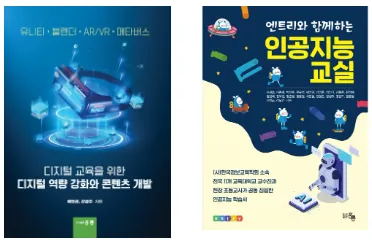
- Bae, Y., & Kang, S. (2024). Digital empowerment and content development for digital education with Unity, Blender, Metaverse. Hongpub, 406.
- Lee, J., Lee, Y., Park, S., Han, K., Bae, Y., Kang, S., & et al. (2021). Artificial intelligence classroom with Entry. Hongpub, 373.
- Kang, S. (2026, April 14). Let’s Build with GenAI: Designing Learning Experiences Through Computational Thinking and Planning [Conference presentation]. 2026 Purdue AI Research Showcase, West Lafayette, IN, United States. https://www.purdue.edu/science/events/science/2026/purdue-ai-research-showcase.html
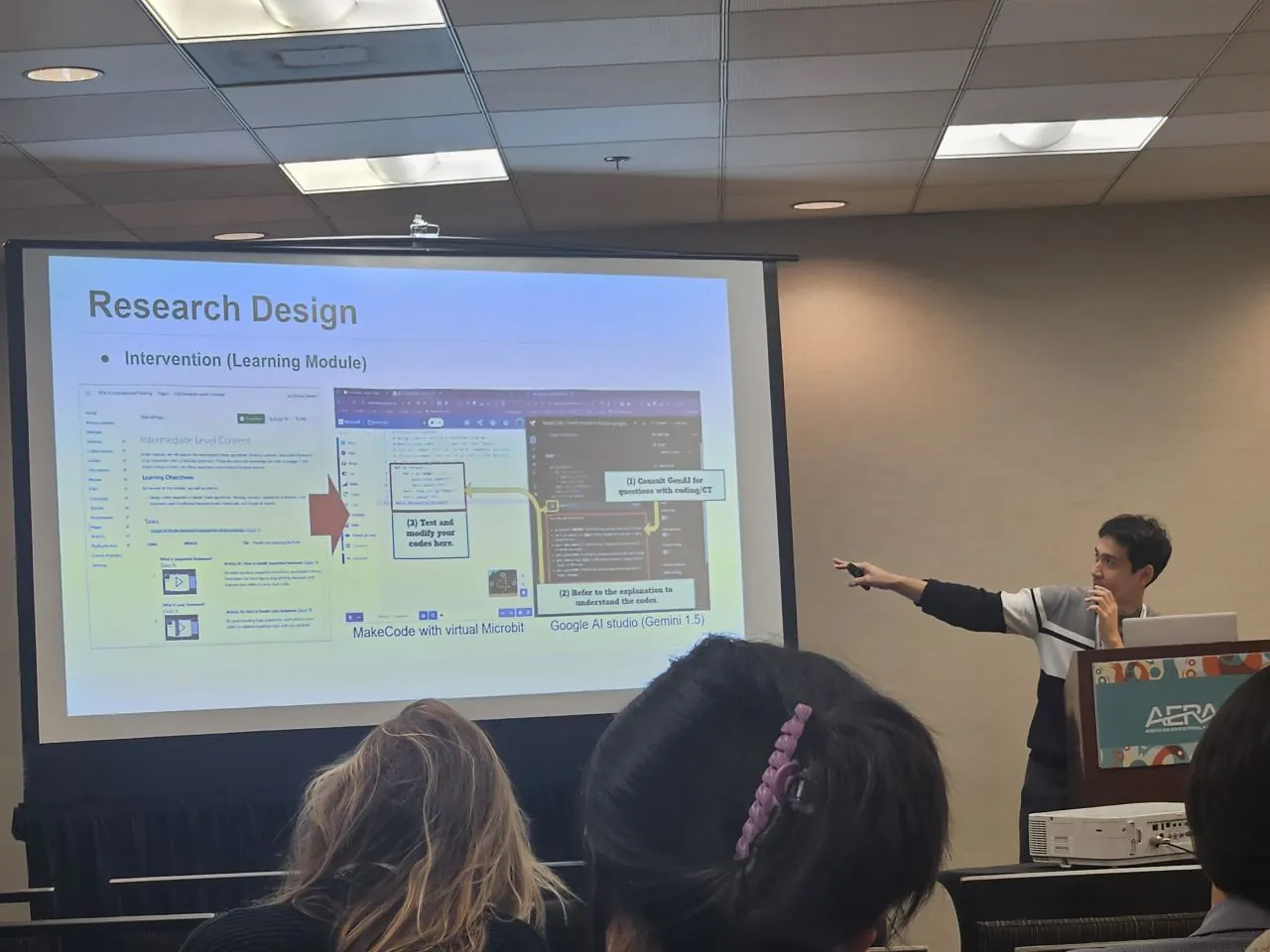
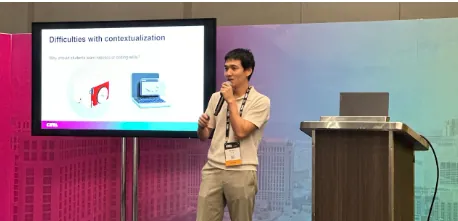
- Kang, S., & Huang, W. (2026, April 10). Enhancing K‑12 Educators’ Coding and Computational Thinking Skills and Values with a GenAI‑Supported Online Module [Conference presentation]. 2026 American Educational Research Association (AERA) Annual Meeting, Los Angeles, CA, United States. https://www.aera.net/
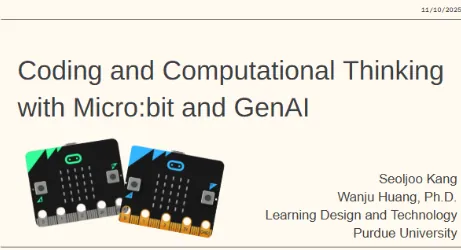
- Kang, S., & Huang, W. (2025, November 10). Coding and Computational Thinking with Micro:bit and GenAI [Conference presentation]. Purdue AI in P-12 Education Conference, West Lafayette, IN, United States.
- Feng, W., Huang, W., Kang, S. (2025, October 23). Exploring Self-Directed Learning with GenAI: Insights from Programming Beginners. [Conference presentation]. 2025 Association for Educational Communications and Technology (AECT) Annual Meeting, Las Vegas, NV, United States. https://www.aect.org/
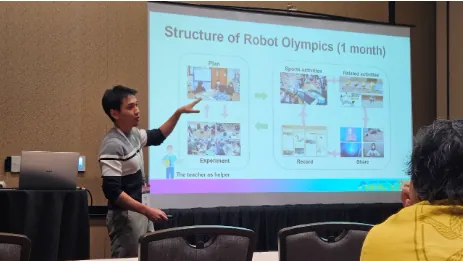
- Kang, S., & Huang, W. (2025, October 21). Robot Olympics: Engaging in Coding and Computational Thinking through Project-Based Learning in K-12 Education [Conference presentation]. 2025 Association for Educational Communications and Technology (AECT) Annual Meeting, Las Vegas, NV, United States. https://www.aect.org/
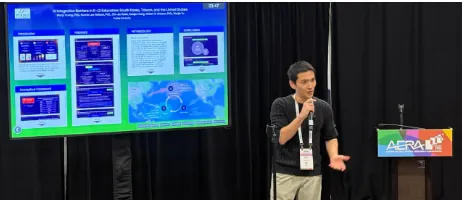
- Huang, W., Watson, S., Hsieh, C., Kang, S., Watson, W., & Yu, W. (2025, April 28). AI integration barriers in K-12 education: South Korea, Taiwan, and the United States [Conference presentation]. 2025 American Educational Research Association (AERA) Annual Meeting, Denver, CO, United States. https://www.aera.net/
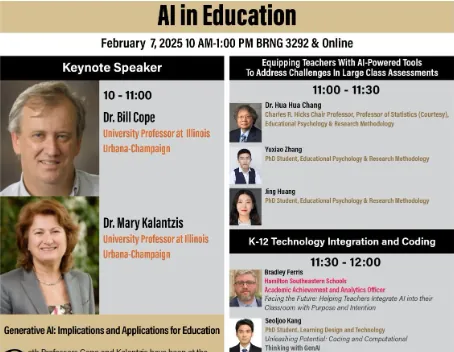
- Kang, S. (2025, February 7). Unleashing Potential: Coding and Computational Thinking with GenAI [presentation]. Purdue Power Friday, West Lafayette, IN, United States. https://education.purdue.edu/events/power-friday-ai-in-education/
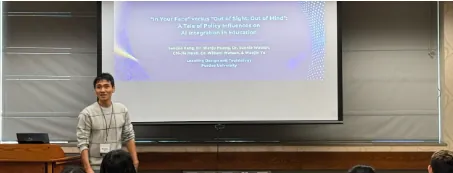
- Kang, S., Huang, W., Watson, S., Hsieh, C.-J., Watson, W. R., & Yu, W. (2024, November 11). A Comparative Study of AI Integration Barriers in K-12 Education in South Korea, Taiwan, and the United States [Conference presentation]. Purdue AI in P-12 Education Conference, West Lafayette, IN, United States. https://web.cvent.com/event/5e3c64a7-41cb-4c44-9ac5-fe69c2449b59/websitePage:645d57e4-75eb-4769-b2c0-f201a0bfc6ce?i=gDzrjGl6o0qg--lkxySY9w&locale=en-US
- Yu, W., Watson, S. L., Kang, S., Huang, W., Hsieh, C.-J., & Watson, W. R. (2024, November 11). AI integration in K-12 education: South Korean teachers' perspectives [Conference presentation]. Purdue AI in P-12 Education Conference, West Lafayette, IN, United States. https://web.cvent.com/event/5e3c64a7-41cb-4c44-9ac5-fe69c2449b59/websitePage:645d57e4-75eb-4769-b2c0-f201a0bfc6ce?i=gDzrjGl6o0qg--lkxySY9w&locale=en-US
- Kang, S., & Yu, W. (2024, July 18). Successful CS Integration with Project Based Learning [Conference presentation]. 2024 CSTA annual conference in Las Vegas. https://conference.csteachers.org/event/f0c0e0a8-5ac1-4333-90c9-2eab9723af76/websitePage:03ec16c0-72ae-4baf-9e20-c727f880b8d1
- Yu, W., & Kang, S. (2024, July 18). Support AI-Integrated Teaching and Learning: Lessons from South Korea [Conference presentation]. 2024 CSTA annual conference in Las Vegas. https://conference.csteachers.org/event/f0c0e0a8-5ac1-4333-90c9-2eab9723af76/websitePage:03ec16c0-72ae-4baf-9e20-c727f880b8d1
- Kang, S. (2024, April 14). Exploring the Impact: Teachers' Perspective on Digital Competence Through Digital Content Creation [Conference presentation]. 2024 AERA annual meeting in Philadelphia. https://www.aera.net/
- Kang, S. (2024, March 29). AI-Powered Digital Application Creation for Teachers' Digital Competence. Presentation at the Annual Graduate Student Education Research Symposium (AGSERS) at Purdue University. https://purduegsec.weebly.com/agsers-2024.html
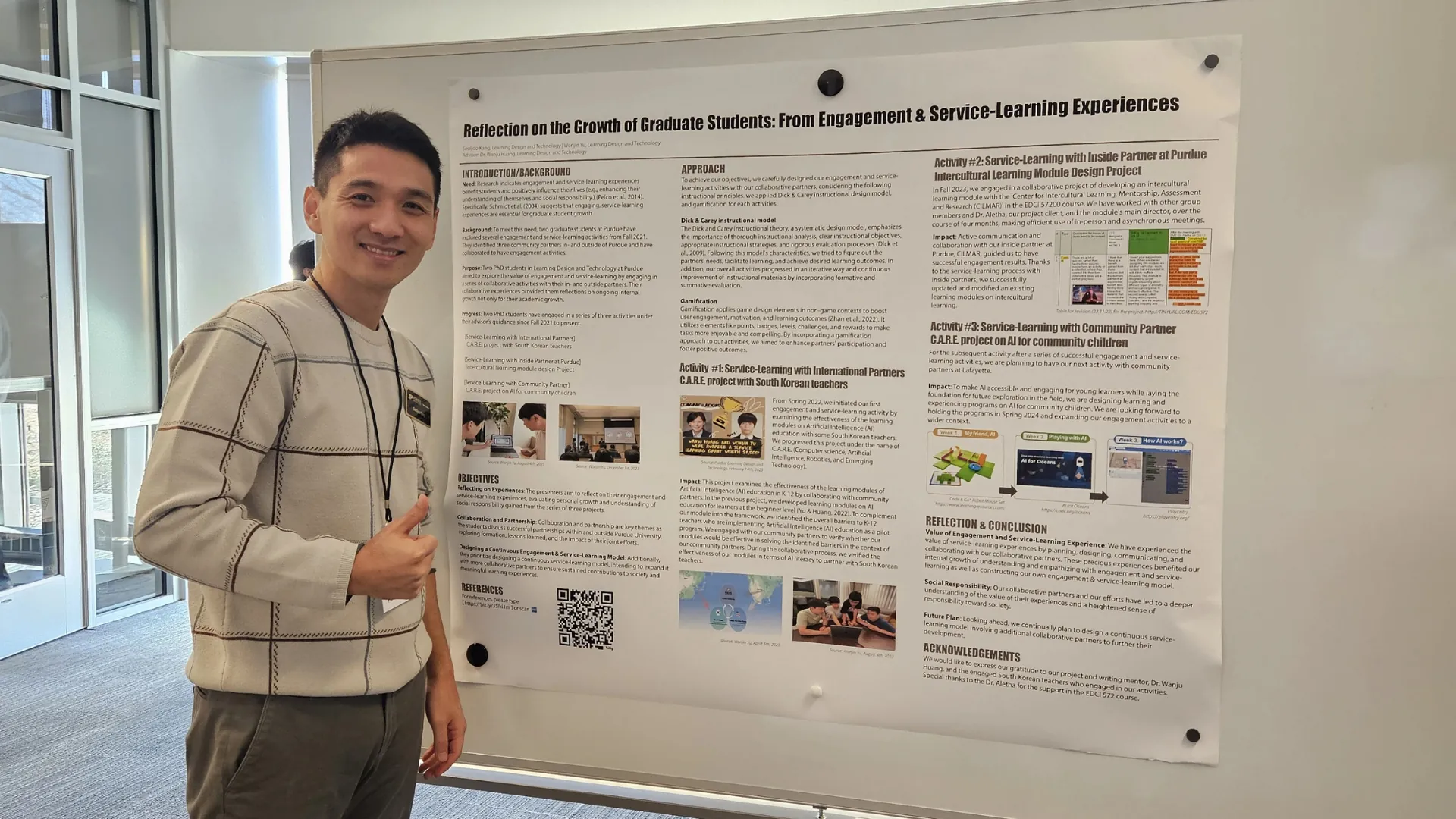
- Kang, S., & Yu, W. (2024, February 29). Reflection on the Growth of Graduate Students: From Engagement & Service- Learning Experiences. Presentation at the engagement and service-learning summit at Purdue University. https://www.purdue.edu/engagement/showcase-2024-presentations/
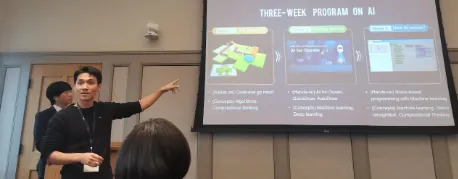
- Yu, W., Kang, S., & Huang, W. (2023, December 1). CARE (computer science, artificial intelligence, robotics, and emerging technologies) @ Purdue [Conference presentation]. Trustworthy AI Lab for Education Summit, South Bend, IN, United States. https://lucyinstitute.nd.edu/trustworthy-ai-lab-for-education-summit/

-
Ross-Lynn Research Scholar, College of Education, Purdue University
(Summer 2026)
- Awarded for the research: "A GenAI-Supported Knowledge Grounded Scaffolding System for Graduate Study Planning: A Pilot Study."
- Graduate Student Hackney Travel Award, College of Education, Purdue University (2025)
- Graduate Student Travel Award, Department of Curriculum & Instruction, Purdue University (2025, 2024)
- Learning Design and Technology (LDT) Travel Grant, Department of Curriculum & Instruction, Purdue University (2025, 2024)
- The 1st Korea Information Education Award, The Ministry of Education in South Korea (2021)
- The 36th Elementary School Teacher Class Presentation Contest Award, Daegu Metropolitan Office of Education (2021)
- The 51th National Educational Materials Exhibition Award, Korean Federation of Teachers' Associations (2020)
- The 40th Daegu Metropolitan City Educational Materials Exhibition Award, Daegu Metropolitan City Superintendent of Education (2020)
- Certificate of commendation for Regional Education Emphasis Promotion, Daegu Nambu Office of Education (2020)
- Scholarship of artificial intelligence convergence education in connection with the Graduate School of Education, Daegu Metropolitan Office of Education (2020)
- National excellent scholarship in science and engineering, Korea Student Aid Foundation (2005)